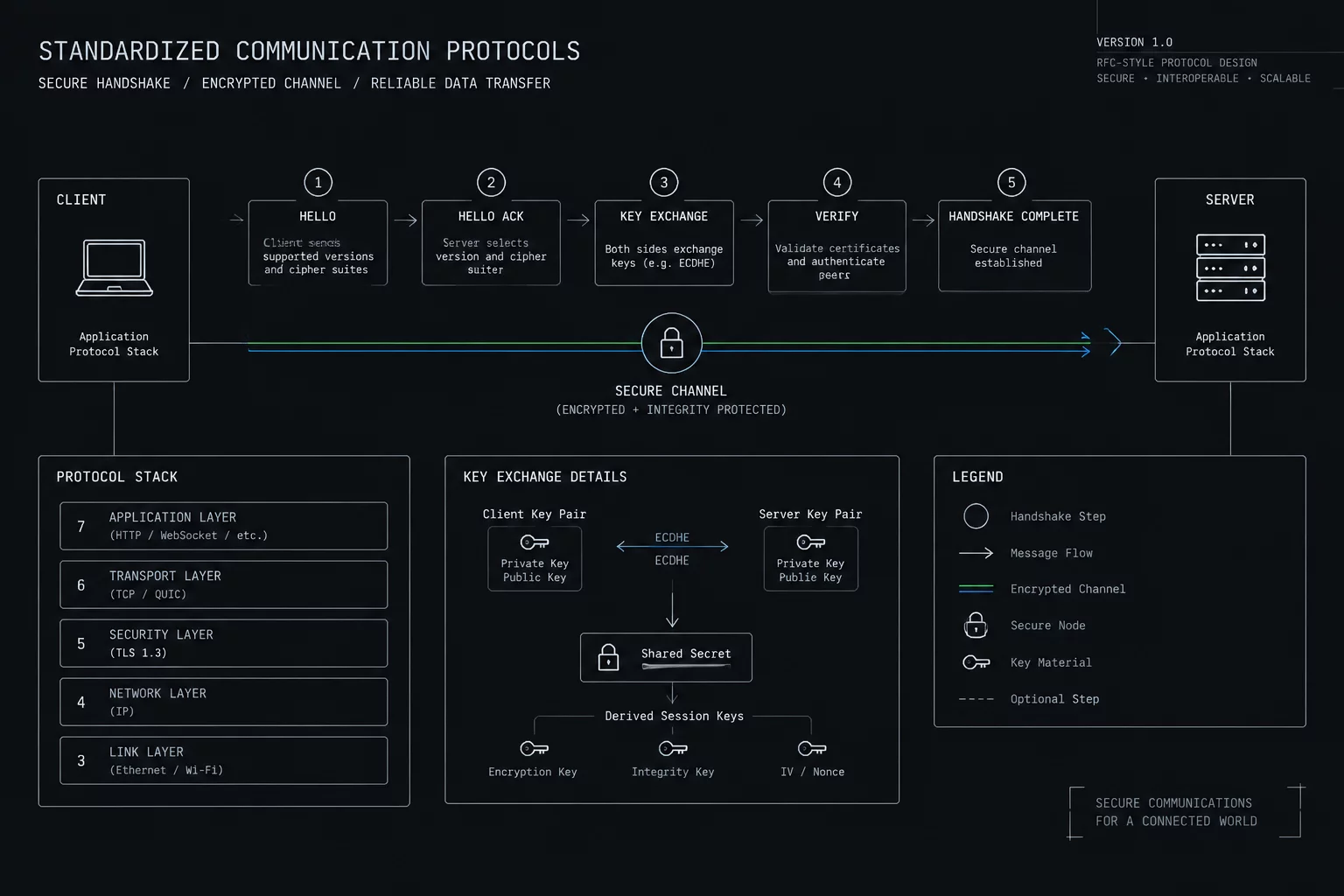
The Demise of Point-to-Point REST Under Autonomous Execution Loads
Traditional REST architectures rely on deterministic client-server paradigms where client calls follow established sequences, predictable payload schemas, and known execution timing. In autonomous agent ecosystems, however, large language models execute recursive decision trees, unpredictable sub-task spawning, and non-deterministic tool discovery at machine velocities. When production clusters attempt to bridge dozens of legacy REST services via static glue scripts, the architecture suffers severe structural collapse: schemas desynchronize, HTTP connection pools experience immediate thread starvation, and token utilization spirals through redundant schema transmissions.
The newly published Agent Integration Architecture Standard formalizes the transition toward the Model Context Protocol (MCP). Under this standard, services no longer expose static REST endpoints directly to agent prompts. Instead, systems expose standardized MCP servers providing isolated resources, dynamic tool manifests, and structured prompt templates over bidirectional, state-aware channels. Opens-Rout gateway acts as the central routing governor, standardizing session state, enforcing token compression, and maintaining cryptographic verification across all downstream tool calls.
Architectural Foundations of the Model Context Protocol
The MCP specification resolves the fragmentation of proprietary tool-calling interfaces by establishing a universal handshake contract between reasoning engines and real-world execution environments. By dissociating agent planning cycles from transport network protocols, applications prevent model drift while allowing distributed teams to upgrade internal database tools, search pipelines, and file system handlers without re-tuning agent prompts or recompiling pipeline graph dependencies.
Mandatory Production Requirements for Enterprise Agent Integration
Production compliance with RFC-22F4 mandates strict adherence to four architectural invariants across all agent runtime nodes:
- Dynamic Schema Reflection: Tool signatures declare capability manifests dynamically using JSON-RPC schemas rather than hardcoded client interfaces.
- Contextual Memory Segregation: Long-term enterprise state stays isolated in dedicated MCP resource providers, preventing unvetted tokens from polluting active context windows.
- Kernel-Level Sandbox Boundaries: Shell commands and system utilities execute exclusively in containerized environments with zero direct host privilege escalation paths.
- Backpressure Flow Control: Event loops automatically throttle agent invocation velocity when target microservice latency breaches acceptable SLA boundaries.
Standardized Integration Matrix & Service Benchmarks
| Attribute | Value | Implementation Detail |
|---|---|---|
| Transport Protocol | HTTP/2 SSE & stdio | Multiplexed bidirectional streams with sub-5ms handshake serialization overhead |
| Schema Discovery | JSON-RPC 2.0 Dynamic | Real-time tool inspection requiring zero orchestrator rebuilds upon upstream patch |
| Resilience Governor | Adaptive Circuit-Breaker | Automated query backoff and context preservation during provider HTTP 429 throttling |
| Identity Verification | mTLS & Ed25519 Nonces | End-to-end cryptographic provenance preventing prompt injection replay attacks |
Frequently Asked Questions
REST contracts assume deterministic client workflows with fixed query parameters and low coordination frequency. Autonomous agents execute iterative reasoning loops where tool discovery, nested sub-calls, and parameter exploration occur organically. When hundreds of autonomous agents invoke REST microservices simultaneously, the resulting volume of full schema headers, connection churn, and uncoordinated retries rapidly overwhelms standard load balancers and depletes LLM token allocations.
In legacy setups, every tool definition must be injected directly into the LLM system prompt on every generation round, consuming thousands of tokens per step. MCP introduces dynamic tool discovery where tools are queried on-demand and resources are exposed via standardized URIs. The agent only pulls specific payload schemas and data segments when actively invoked, slashing unnecessary token overhead by up to 60 percent across complex multi-step workflows.
Engineering teams do not need to rewrite their underlying enterprise services from scratch. Opens-Rout deploys intermediate MCP adapter proxies that ingest existing OpenAPI and GraphQL definitions, presenting them to upstream agent clusters as compliant MCP tool servers. The gateway manages mutual TLS authentication, context window compaction, and rate-limit buffering automatically within secured regional boundaries.
Adopt the Enterprise Agent Architecture Specification
Receive implementation guides, production schema definitions, and MCP integration templates curated directly by Opens-Rout architects.