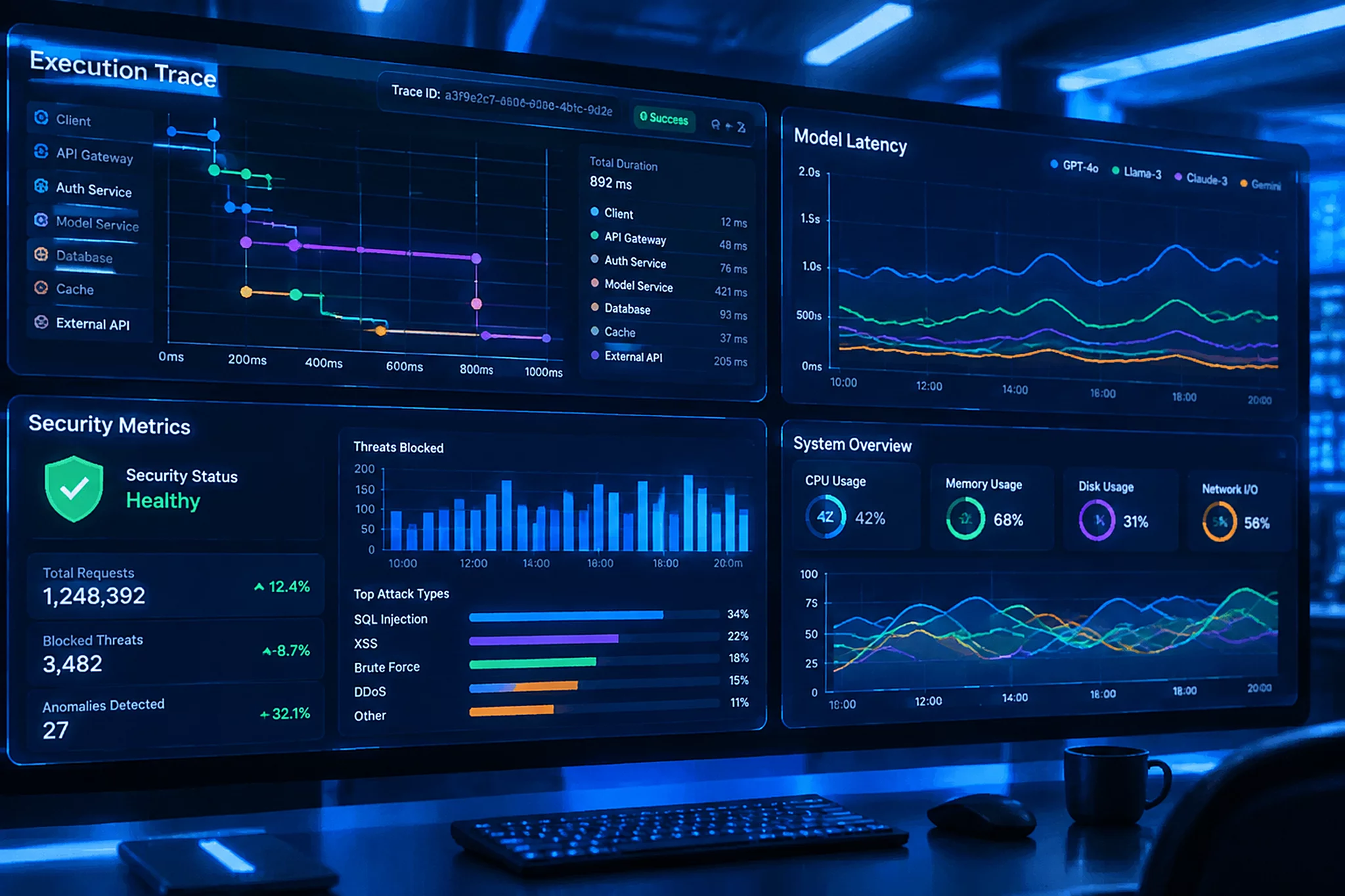
Architectural Shift in Agentic Observability
Autonomous agent frameworks frequently struggle with diagnostic opacity when internal execution steps diverge across cyclic tools and dynamic prompt state trees. Standard request-response metrics fail to surface where an individual model drifted off task or why a retrieval query returned ungrounded context. The latest release introduces dedicated span-level telemetry tailored directly for non-linear agent graphs, capturing execution pathways at each intermediate reflection boundary.
By integrating directly into the MLflow tracking engine, development teams inspect multi-stage reasoning traces alongside latency percentiles and token expense. Each tool execution automatically registers as a contextual sub-span within a parent session, enabling rapid root-cause isolation whenever recursive agents encounter execution loops or security boundary alerts.
Deep Inspection of Reasoning Traces and Gateway Routing
Traditional model registries focus purely on weights, artifacts, and simple prompt completions. As autonomous agent workflows become standard across enterprise systems, runtime behavior depends far more on real-time decisions, tool payloads, and memory retrieval fidelity. The platform addresses this transition by decoupling trace storage from simple execution logs, establishing an immutable audit record for every agent decision.
Key Telemetry and Governance Features
Engineers deploying multi-agent swarms gain granular oversight across external model calls and localized sandboxed execution containers:
- Granular Multi-Step Execution Spans capturing dynamic tool-calling branches and intermediate reasoning tokens without payload truncation.
- Unified AI Gateway Telemetry mapping decentralized provider endpoints to centralized audit trails and latency quotas.
- Automated LLM-as-a-Judge Evaluation Suites scoring multi-turn goal completion, factual grounding, and toxicity flags in real time.
- Sandboxed Trace Storage with granular role-based access control protecting proprietary prompts and user-identifiable context.
System Capabilities and Runtime Specifications
| Attribute | Value | Implementation Detail |
|---|---|---|
| Tracing Ingestion Protocol | OTel GenAI Standard v1.34 | Native streaming exporter with automatic non-blocking batch buffers |
| Trace Capture Latency | Under 2.4ms (p99) | Zero runtime degradation during multi-agent loop orchestration |
| Evaluator Frameworks | MLflow Evaluate + Custom Heuristics | Supports automated hallucination checks and goal fulfillment scoring |
| Gateway Compatibility | Opens-Rout Single-Key API | End-to-end trace propagation across heterogeneous model backends |
Frequently Asked Questions
The platform introduces hierarchical span tagging that automatically traces parent-child relationships across asynchronous worker threads. When an orchestrator delegates tasks to specialized sub-agents, MLflow binds each reasoning branch to the root trace ID. This structure visualizes recursive loops, tool execution bottlenecks, and token consumption breakdowns across all participating nodes without requiring custom middleware.
Telemetry data is buffered asynchronously in memory and dispatched via lightweight background workers using OpenTelemetry gRPC pipelines. Benchmarks indicate that capturing comprehensive reasoning steps and tool arguments adds less than 2.4 milliseconds at the 99th percentile, ensuring mission-critical autonomous agents maintain real-time responsiveness.
Yes. The AI Gateway incorporates customizable regex filters and entity masks that intercept payloads before they reach the tracking store. API keys, session tokens, and designated personal identifying information are obfuscated in memory, maintaining enterprise compliance without distorting performance traces or debugging fidelity.
Stay Ahead of Autonomous Agent Architecture
Receive technical whitepapers, trace schemas, and production deployment advisories directly from our platform engineers.